
REVIEW · GREECE
Rethymno Walking & Gastronomy Tour
Rethymno’s best food lesson comes with a side of old-town history. This three to four-hour walk moves from a quiet kafeneio and honey-covered sfakianopita to olive oil, raki, handmade filo, and a generous Cretan meal in a former Venetian and Ottoman building.
I like the small group limit of eight, which lets guides such as Nora, Michael, Vincent, and Dina adjust the pace and conversation. I also like the real local connections, especially the visit to Giorgos Chatziparaschos’s long-running filo workshop. The main caution is timing: most of the food arrives at the final meal, so this is not a series of tiny bites all along the route.
Key points at a glance
- Breakfast begins with sfakianopita: Start with coffee or juice and a handmade cheese pie covered in organic thyme honey.
- A working filo atelier adds substance: See how thin kadaifi pastry is made in a 17th-century Venetian mansion.
- The final meal is substantial: Expect Cretan mezedes, wine, raki, and enough food to function as lunch or dinner.
- The group stays small: A maximum of eight people makes it easier to ask questions and hear the guide.
- The tour connects food and place: Olive oil, honey, raki, pastries, and meze are explained alongside Rethymno’s customs and past.
- Fortezza can follow: The guide can help you reach the fortress after the tour, though its entrance ticket is extra.
Why this Rethymno food walk works
Many food tours are really restaurant crawls with a few facts added between courses. This one has a clearer shape. You begin gently with breakfast, learn about key Cretan products, see a traditional pastry being made, and finish with a full meal.
That order matters. By the time you sit down to the mezedes, you have some context for the ingredients in front of you. You have heard about Cretan hospitality, seen how local pastry is produced, and sampled the products that shape the island’s table.
The walking also gives the food a setting. The route takes place in Rethymno’s old town, with stops in historic buildings and small local businesses rather than only polished dining rooms. Guides have described the city’s customs, Ottoman connections, Venetian-era buildings, and the place of raki in daily hospitality.
The experience is offered in a small group, capped at eight people. That is a useful number for a walking tour. You are not trying to hear a guide over a crowd, and the guide can respond to your interests. Several guides are named in the tour material, including Nora, Kostas, Michael, Dina, Maria, Vincent, Milo, and Hara. The exact guide depends on the date, but the format favors a personal conversation.
At $107.63 per person, this is not a cheap snack walk. The price includes the guide, all listed tastings, coffee or juice, traditional snacks, wine, raki, and a full lunch or dinner with a vegetarian option. If you treat the final meal as a proper restaurant meal and value the history and introductions along the way, the cost is easier to justify.
A few more food tours around Greece worth comparing
- Greek Food Walking Tour in Athens
★ 5.0 · 4,740 reviews - Athens: Guided Greek Food Walking Tour with Tastings
★ 4.9 · 2,859 reviews - Athens Authentic Greek Food Walking Tour (Small Group)
★ 5.0 · 809 reviews
Starting with coffee and sfakianopita
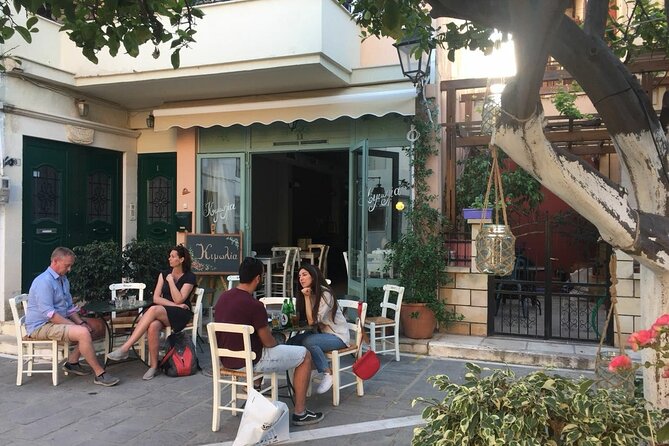
The meeting point is the Church of the Four Martyrs on Gerakari 6. From there, the first stop is a quiet kafeneio in a distinctive part of the old town.
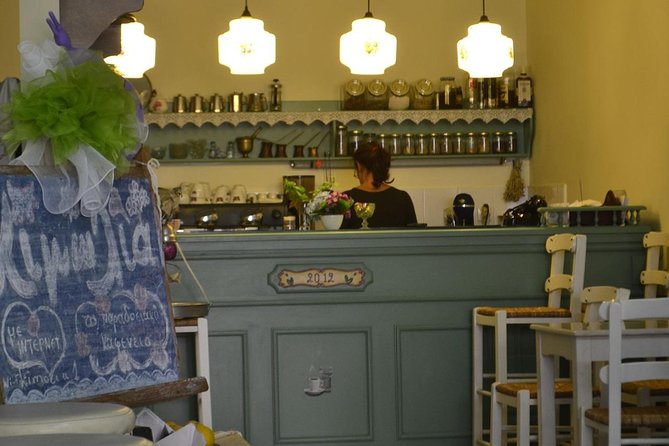
You begin with traditional Greek coffee or juice and a handmade cheese pie called sfakianopita. The pie is served with organic thyme honey, a simple combination that introduces two important Cretan flavors: salty cheese and fragrant local honey.
This first half-hour is more than a quick pastry stop. The guide uses breakfast to explain the plan, Cretan customs, food traditions, and the connection between local life and gastronomy. It gives you time to settle into the pace before the walking and tasting gather momentum.
A shaded setting has been used for this breakfast, including a calm garden-like spot during one tour. The exact location and atmosphere can vary, but the point is consistent: this is an unhurried opening rather than a rushed coffee pickup.
If you want a large breakfast, keep your expectations sensible. The sfakianopita is a traditional snack, not a full morning spread. Its value is in the introduction and the explanation, while the larger meal comes later.
Olive oil, honey, and raki in the old town
The next stop focuses on local products, including olive oil, tsikoudia, and honey. Tsikoudia is the local grape spirit commonly called raki, and it plays a central part in Cretan hospitality.
This tasting is useful because olive oil and honey can look simple on a menu but have a major place in Cretan cooking. You learn how to recognize authentic olive oil and honey, according to the tour’s food discussion, rather than simply being handed a sample with no explanation.
Raki is served as part of the tour, and there is plenty of laughter built into the experience. Keep one detail clear: the traditional spirit itself is not presented as a long flight of different flavors. If you expect several varieties, you may find this part more limited than the wording suggests.
A past tour adjusted the tasting with extra samples such as sheep’s milk ice cream and fried honey balls. That kind of change is possible, but it should not be treated as guaranteed. The fixed focus is local products, not an endless parade of samples.
Inside the 17th-century filo workshop
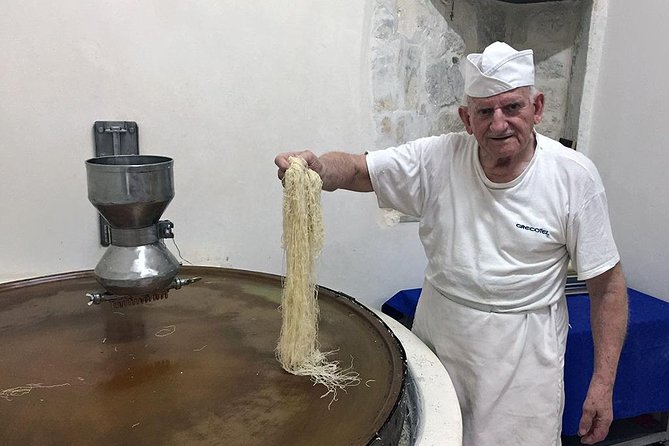
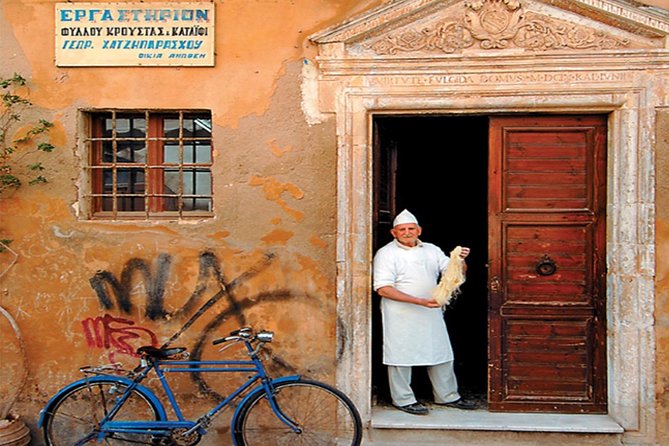
The most distinctive stop is the traditional filo atelier operated by Giorgos Chatziparaschos. It is located in a Venetian mansion dating from the 17th century and has been making traditional filo for about 65 years.
The workshop specializes in filo for kadaifi and baklava. The ingredients are basic: flour, water, and salt. The skill lies in the proportions and handling, which took years of testing to refine.
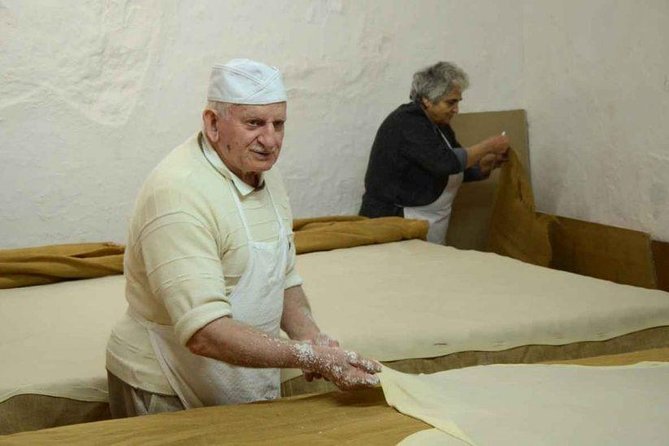
If production is underway, you can watch the pastry being made. A fluid mixture enters a special machine in the back room, and a hot copper pan keeps turning. Above the flames, thin baked strands form the kadaifi pastry. Butter aromas fill the space as the pastry takes shape.
This is a good example of why the tour is not just about eating. You see the labor behind a dessert that many people know only after it has been soaked in syrup. Kadaifi is finished with cinnamon and chopped walnuts, then dipped in honey or syrup. Seeing its delicate threads made by hand gives the final sweet a little more meaning.
The stop lasts about 30 minutes, so do not expect a long cooking class. You watch and learn rather than make a full tray yourself. Production is not guaranteed at every moment, but the workshop itself is a worthwhile window into a traditional craft.
Same city, a completely different plate:
- Athens: Street Food Tasting Tour
★ 4.9 · 3,343 reviews - Small Group Greek Traditional Food Tour in Athens 20+ Tastings
★ 5.0 · 1,759 reviews - Athens: Food Market Visit and Cooking Class with Wine
★ 4.9 · 1,087 reviews - Athens Greek Food Tour Small-Group Experience
★ 5.0 · 802 reviews
The Venetian and Ottoman setting of Ali Vafi’s Garden
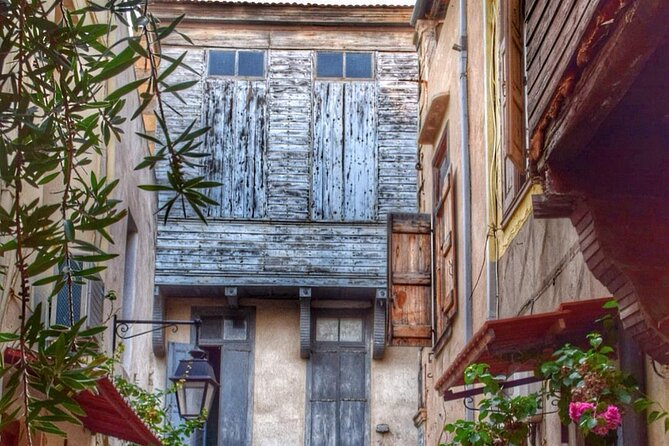
The final stop is Ali Vafi’s Garden, a tavern in a building from the Venetian era that was later occupied by the Ottomans. The setting gives the meal a strong sense of place, and the guide continues to explain Rethymno’s past while the food arrives.
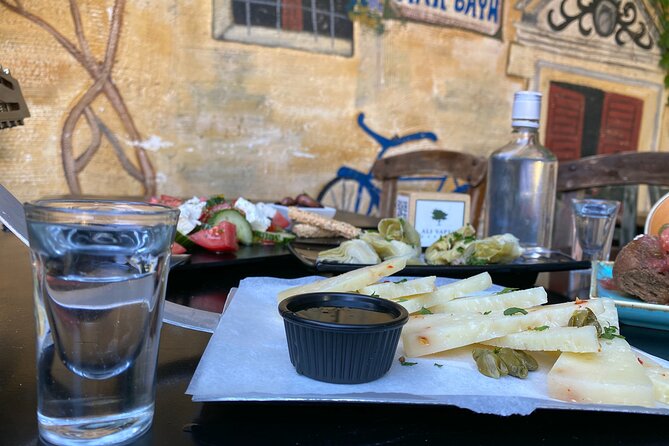
The menu is built around mezedes, small shared dishes associated with Cretan and Ottoman cooking. You may be served a salad with tomato, cucumber, artichoke, and bread croutons, along with black beans and smoked trout, graviera goat cheese, and an organic sausage sheet.
White, red, and rosé wine are included, as is raki. This is not a token tasting at the end of a long walk. The food is intended to add up to a full lunch or dinner, and the portions can be more generous than some people expect from a tasting tour.
The shared format suits people who like to sample several things rather than order one main course. It also works well for a family-style meal, with the guide able to adjust selections for individual palates. A vegetarian option is included, but you should make your needs clear when booking or at the start of the tour.
The location is also used as a friendly bar in the evening, with cocktails on the menu. During the tour, the emphasis is on meze, conversation, and local food rather than nightlife.
The walking and the history between bites
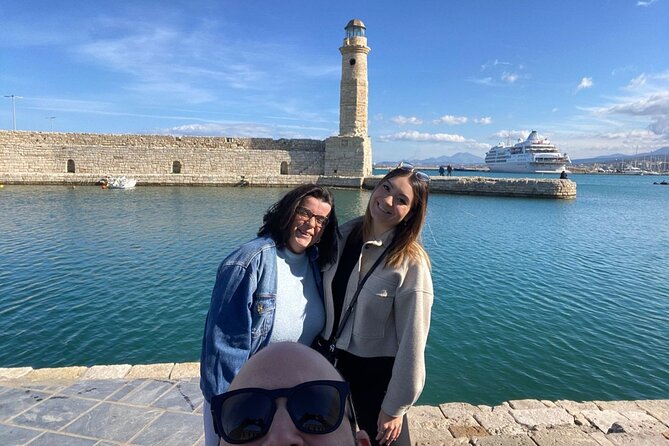
The route is not a formal sightseeing tour with every major monument covered. Its strength is the way the guide ties small details to food and daily life.
You move through the old town to local businesses and historic buildings. Guides have helped visitors understand Rethymno’s Venetian and Ottoman layers, pointed out places to eat during the rest of a stay, and offered practical suggestions such as local shops and taxi contacts.
The tone can vary by guide. Nora has been described as warm and engaging, while Michael has tailored the conversation and food choices to the group. Vincent is noted for personal relationships with the people visited along the route, and Hara has led visitors through narrow lanes to local places they might not have found alone.
Those details matter because the tour depends heavily on the guide. The food is important, but the guide turns separate tastings into a connected experience. A good guide helps you understand why raki is offered, how olive oil is judged, and how the city’s past appears in its buildings and cuisine.
The tour has also been adapted in response to conditions. During bad weather, an additional stop was found to get the group out of heavy rain. That flexibility is reassuring, but the experience still requires good weather and may be rescheduled or canceled if conditions are poor.
How much food do you really get?
The tour description promises enough food for a hearty meal, and the final stop carries most of that weight. You receive breakfast, product samples, pastry-related tasting, drinks, and a full lunch or dinner.
Still, I would not book this expecting a bite at every few minutes. One past participant found the olive oil tasting longer than needed and expected more small dishes during the walking portion. The same experience was praised for its excellent final lunch, but the wait for that meal felt long.
That is the most useful expectation to set. Think of this as a food-focused cultural walk with a substantial closing meal, not a continuous grazing tour. If you like sitting down for a proper shared meal, the pacing should suit you. If you want constant street-food samples, you may prefer a different format.
Raki is included, but the amount and presentation can vary. The traditional drink is generally one basic spirit rather than a tasting of many distinct raki styles. Some extra items may appear, but they are not promised.
Price, group size, and practical value
At $107.63, the tour makes the most sense for someone who would otherwise pay separately for a good meal, several tastings, and a guided old-town walk. You are also paying for access to small producers and workshops that can be hard to arrange independently.
The maximum group size is eight. Group discounts are available, and a private upgrade is offered if you want the route and conversation reserved for your own party.
The tour runs for roughly three to four hours and ends back at the meeting point. It begins at the Church of the Four Martyrs, so you can plan another old-town activity before or afterward. If you want to visit Fortezza afterward, the guide can help you reach its entrance, but the fortress admission ticket is not included.
The tour is offered in English, with local English or French-speaking guides listed among the inclusions. Mobile tickets are accepted, and confirmation is provided at booking. Service animals are allowed, public transportation is nearby, and most people can take part.
Free cancellation is available up to 24 hours before the start time. Changes made inside that window are not accepted, and poor weather or failure to meet the minimum group size can lead to a different date, another experience, or a full refund.
Who will enjoy this tour most?
I would choose this for a first day or two in Rethymno. The food gives you a useful introduction to Cretan flavors, while the guide can point you toward restaurants and shops for the rest of your stay.
It suits people who enjoy conversation, local history, and shared dishes. Families can benefit from the flexible pace, and one French-language review indicates that teenagers enjoyed the food and city introduction as well.
It is also a good pick for visitors who prefer small businesses to large commercial attractions. The kafeneio, filo atelier, local tasting stop, and tavern all give the experience a neighborhood feel.
You should think twice if you want a fast route, a formal cooking class, or a nonstop sequence of samples. The walk includes conversation and historical explanation, and the biggest food payoff comes at the end.
Should you book the Rethymno Walking and Gastronomy Tour?
Book it if you want Rethymno explained through its food, with a real sit-down meal rather than a handful of nibbles. The filo workshop, organic thyme honey, Cretan cheese, olive oil, raki, and Ali Vafi’s Garden give the tour plenty of texture.
I especially like the small group size and the chance to see a working pastry tradition in an old Venetian building. Just set your expectations correctly: breakfast and tastings start the day, but the generous meal arrives later.
For a relaxed introduction to Rethymno, this is a strong choice. For a rapid food crawl, it is less convincing. The deciding question is simple: do you want to eat while learning how the city lives, or do you want to eat as quickly as possible?
FAQ
How long does the Rethymno Walking and Gastronomy Tour last?
The tour lasts approximately three to four hours.
Where does the tour begin?
It begins at the Church of the Four Martyrs, Gerakari 6, Rethymno 741 31, Greece.
Where does the tour end?
The activity ends back at the meeting point.
How many people can join the tour?
The group has a maximum of eight participants. A private upgrade is also available.
Is a full meal included?
Yes. The tour includes a full lunch or dinner, with a vegetarian option, along with breakfast, traditional snacks, wine, raki, and other tastings.
Is the Fortezza entrance ticket included?
No. The Fortezza entrance ticket is not included, although the guide can help you reach the entrance after the tour.
What happens if the weather is bad?
The experience requires good weather. If it is canceled because of poor weather, you can choose another date or receive a full refund.
Just added around Greece
- Heraklion: E-Bike Food Tour – Discover the Flavors of Crete★ 5.0 · 106 reviews
- Heraklion – Walking city tour with food tasting★ 4.5 · 25 reviews
- Crete: Olive Oil, Soap, Wine, Raki – Flavorful Culinary Journey★ 5.0 · 119 reviews
- Traditional Food Tour in Rethymno★ 5.0 · 28 reviews
- Chania Food Stories Half-Day Tour inc. tastings & drinks★ 5.0 · 92 reviews
- Wine Tasting & Food Experience Inside a Cretan Gorge★ 5.0 · 35 reviews
- Heraklion Food Stories Walking Tour with 8 local-favorite stops★ 4.5 · 30 reviews
- Stories of Food and Culture in the Old Town of Corfu★ 5.0 · 24 reviews
Food Tours in Greece, compared.



Small Group Greek Traditional Food Tour in Athens 20+ Tastings
Read our review →
Food Market Visit and Cooking Class with Wine
Read our review →
Athens Authentic Greek Food Walking Tour (Small Group)
Read our review →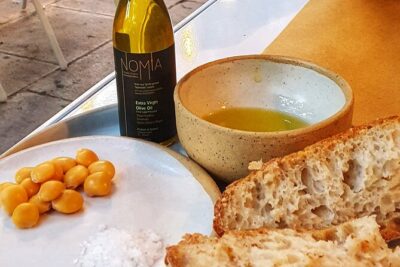
Browse the lists this tour appears in