
REVIEW · BERLIN
East Meets West: Berlin Food Culture & Street Art
Berlin’s food culture makes the most sense when you follow the people who shaped it. This walk connects former East Berlin with Kreuzberg, once West Berlin, using schnitzel, Turkish street food, Ukrainian dishes, currywurst, coffee, and vegan doughnuts as your guidebook.
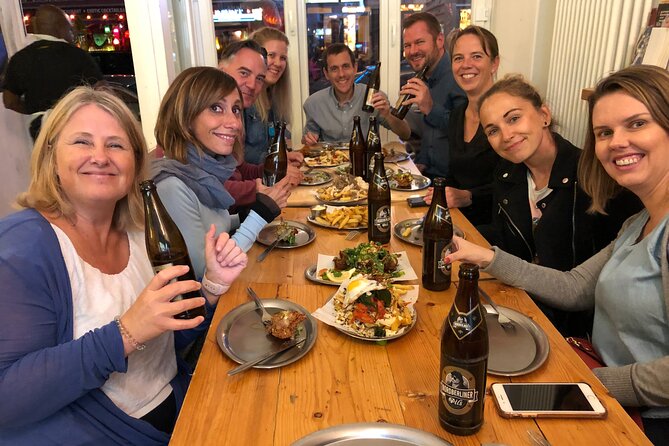
I like the small maximum of eight people, which gives you room to ask questions and keeps the walk from feeling like a parade. I also like the range of stories, from Nazi-era Berlin and the Communist period to the Turkish families who helped remake Kreuzberg and the artists who turned the Berlin Wall into a public canvas.
The main thing to consider is the $169.38 price. That is a serious cost for three and a half hours, and one person found the food and sightseeing too basic for the money. You are paying for a guided food crawl with history and drinks, not a full museum tour or a formal restaurant meal.
Key points to know before you book
- Six local tastings plus drinks: Expect a broad sample of Berlin and immigrant food culture, including German, Turkish, Ukrainian, and vegan stops.
- East Berlin to Kreuzberg: The route begins near Friedrichshain and ends at U Kottbusser Tor, crossing from the former East to the former West.
- A compact group: The tour accepts no more than eight people, a useful setup for questions and personal attention.
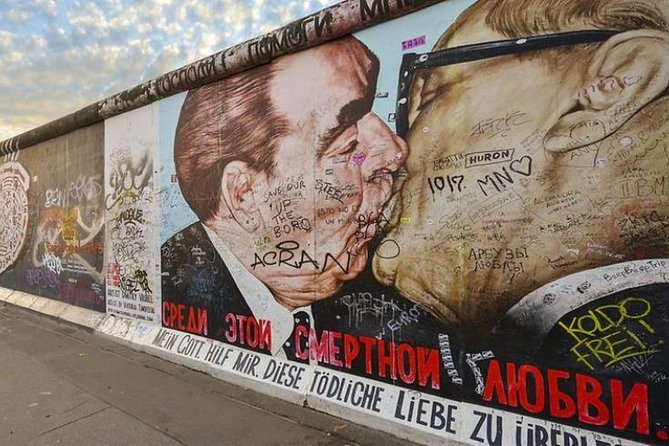
- Street art with political meaning: The East Side Gallery is not just a photo stop. Your guide explains how the remaining Wall became a public art site.
- Come hungry: Portions are generous enough that you may want to skip breakfast, and a normal dinner afterward may feel unnecessary.
- Guides shape the experience: Lee, Elena, Tiago, and Will have all led engaging walks, but the depth of explanation can depend on who leads your group.
From Friedrichshain to the East Side Gallery
Meet at Industriepalast Hostel on Warschauer Strasse at noon. The tour begins in Friedrichshain, a district tied to the old East Berlin and its rebellious residents. You get an early look at the contrast that defines the route: traces of the Communist city beside independent cafés, creative spaces, and newer food businesses.
The first stop is brief, about 20 minutes, so do not expect a long neighborhood lecture or a full architectural tour. Instead, Friedrichshain sets the tone for a walk about change. Your guide can connect the streets to East Berlin’s political past, then show how the area developed its bohemian identity.
The East Side Gallery follows. This is one of the most useful parts of the route for first-time visitors because you see an actual surviving section of the Berlin Wall while also learning how art changed its meaning. The 20-minute stop focuses on political murals and the Wall’s role in separating East and West Berlin.
You should expect time for photos and an explanation of the artwork, but not a museum-style visit. The stop is short, and the tour moves on. If Berlin Wall history is your main reason for booking, plan to visit a museum or memorial separately.
More Food Tours in Berlin
- Berlin Center Food Tour with 8+ Authentic Local Tastings
★ 5.0 · 1,227 reviews - Kreuzberg: Culinary Food Tour
★ 4.5 · 770 reviews - Berlin: Mitte Culinary Food Tour
★ 4.5 · 447 reviews
Coffee, graffiti, and stories from a divided city
The food portion begins with the sort of coffee stop that shows Berlin’s modern side. You visit a fashionable neighborhood coffee shop, where the idea is less about a single famous drink and more about seeing how café culture fits the city’s creative scene.
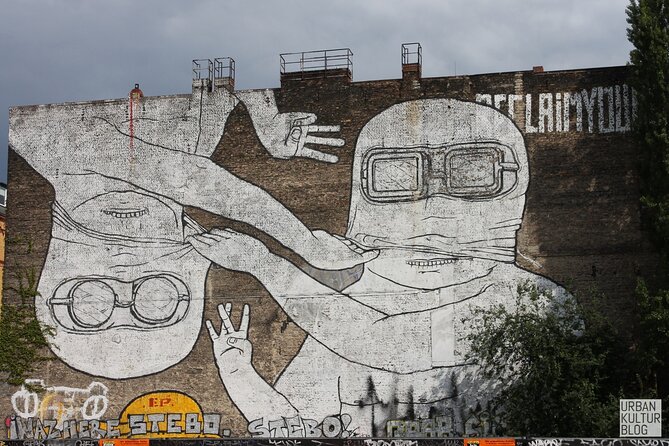
Along the way, the guide points out graffiti and large murals. Berlin street art can look random if you walk past it alone. With context, you get a better sense of how artists use walls to talk about politics, migration, memory, and the future.
The historical material is not limited to the Cold War. The route includes stories from Nazi Germany and traces the movement of SS soldiers through local streets. That gives the walk a darker edge, but it also keeps the food from becoming a disconnected list of snacks. You are learning how neighborhoods carry several layers of Berlin’s past at once.
Guides Lee, Elena, Tiago, and Will are specifically praised for making these connections clear and for answering questions about the city’s culture. Elena, in particular, is described as bringing the areas and local life into focus through stories. Tiago is a good fit for anyone who wants history alongside the food. Still, the depth of the commentary may vary by guide. One less enthusiastic account found the sightseeing explanations fairly basic.
Crossing into Kreuzberg by way of schnitzel
The route then moves into Kreuzberg, the former West Berlin district that became one of the city’s best-known centers for immigrant life, bars, food, and art. This is where the tour’s central idea comes together. You are not simply visiting restaurants. You are following how people, borders, and economic change reshaped a neighborhood.
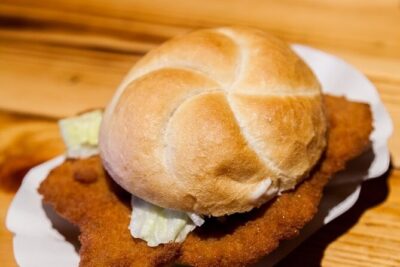
At Scheers Schnitzel, you try a Berlin-style schnitzel at a local institution. The stop lasts about 15 minutes, so think of it as a tasting rather than a leisurely lunch. It gives you a familiar German dish early in the food sequence, before the route shifts toward Berlin’s international influences.
The nearby street-art stop focuses on a well-known mural. The guide explains how East and West, past and future, appear in the city’s public art. This is a strong pairing with the Wall visit: the earlier stop shows art placed directly on a former border, while this one shows how creative work has spread across the neighborhood.
The timing is brisk. You will walk, eat, listen, and move on rather than settle in at each venue. Wear comfortable shoes, and carry a rain jacket or poncho if the forecast looks uncertain. A moderate amount of walking is involved, and Berlin weather can change quickly.
Ukrainian food and the changing face of Berlin
Slava Berlin introduces modern Ukrainian food and nalivanki, a Ukrainian drink. The restaurant is described as immigrant women-led, which adds another human story to the meal. You get a chance to taste contemporary Ukrainian food in Berlin rather than treating the city’s cuisine as only German or Turkish.
This stop matters because Berlin’s food culture is still changing. The city’s immigrant communities are not just part of its past. They continue to open restaurants, bring new flavors, and create work and gathering places.
The menu details can change, and the tour description promises six local tastings rather than a fixed dish list for every stop. If you have allergies or dietary needs, tell the operator at booking. A vegetarian option is available, but you should request it ahead of time.
A few more food tours around Berlin worth comparing
- 3-Hour Atlanta Beltline Food, Street Art and History Tour
★ 5.0 · 345 reviews - Naples: Street Art, Wine and Food Tasting Walking Tour
★ 5.0 · 163 reviews - 2-Hour Food, History and Street Art Tour of Ponce City Market
★ 5.0 · 159 reviews - Phnom Penh | Food & Street Art Half Day Tour by Tuk Tuk
★ 4.9 · 73 reviews
Markthalle Neun and the food behind the food
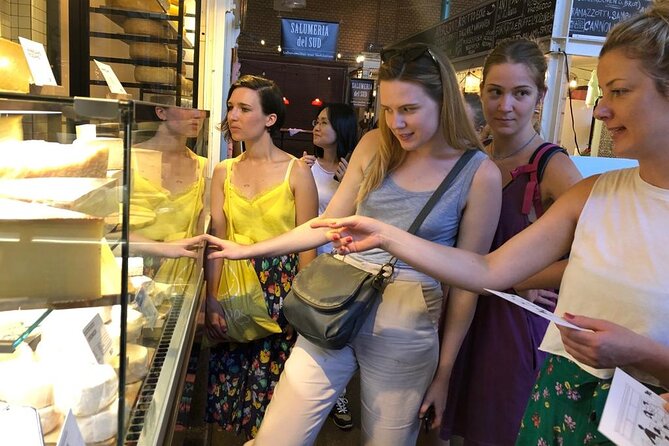
Markthalle Neun is one of the route’s most substantial stops, with about 30 minutes inside the restored market hall. The building dates to the early 1900s and survived World War II damage as well as later pressure to become a more commercial space.
Today, it functions as a meeting point for food producers, cooks, and independent businesses. The tour uses the hall to show how Berlin’s food scene links local ideas with producers and immigrant traditions. You may find this stop more interesting than a simple shop visit because it gives you a sense of the city’s wider food network.
Do not assume that the entire market hall is included as a tasting session. The tour includes food and beverages, but the stop is also about the building and its role in Kreuzberg. If you want time to browse every stall or attend a special market event, you will need to return on your own.
Turkish Kreuzberg, currywurst, and vegan Berlin
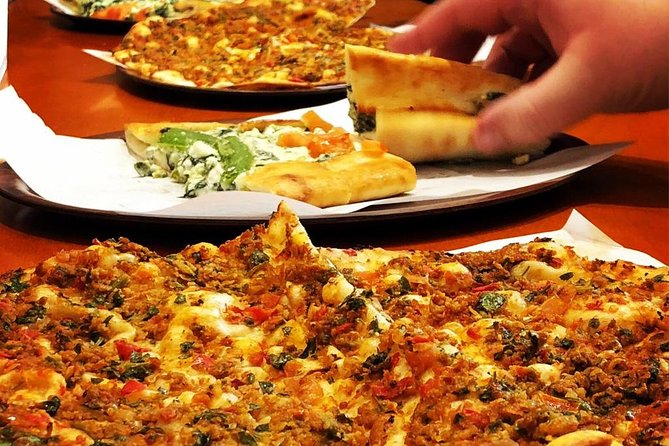
Leylak brings you into the Turkish influence that helped rebuild and reshape Kreuzberg during the 1980s and 1990s. Berlin has the largest Turkish population outside Turkey, and the stop focuses on Anatolian street-food recipes.
This is one of the clearest examples of food as local history. You taste a dish while hearing how Turkish residents changed the neighborhood’s daily life, businesses, and identity. The stop lasts around 20 minutes, enough for a proper sample and a short explanation without turning into a long restaurant meal.
Next comes Ketels Curry and the story of currywurst. The dish is closely tied to Berlin’s postwar identity, and the guide presents an origin story that even some Berlin residents may not know. This is a worthwhile stop for first-time visitors because currywurst is quick, casual, and unmistakably connected to the city.
The final listed food stop is Brammibal’s Donuts at Maybachufer. The vegan doughnuts show yet another side of Berlin’s food scene. The tour frames the city as a leading place for vegan food, and this stop gives you a sweet finish after the savory dishes.
Taken together, the tastings cover a lot of ground: German food, Turkish recipes, Ukrainian specialties, currywurst, coffee, beer, and vegan baking. That variety is the tour’s strongest feature. It also means no single dish receives much time, so book this for range and context rather than a focused food education.
How much food do you actually get?
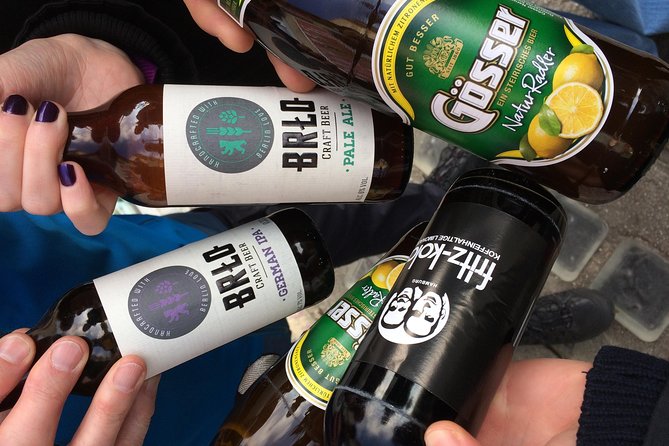
The experience includes six local tastings, beverages, and a Berliner Pilsner beer. The route lists more stops than the six tasting count, because some stops focus on street art, history, or the market hall rather than a separate full serving.
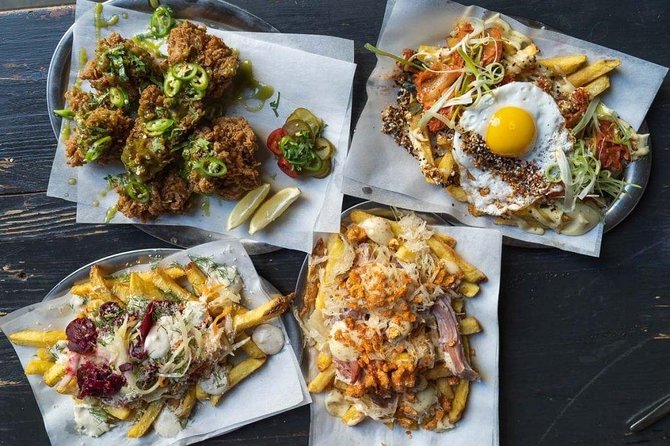
Bring an appetite. One account specifically advises skipping breakfast, and another says the portions were large enough to make dinner unnecessary. That is useful advice, especially since the tour starts at noon. Eat a light breakfast or snack only if you need something early in the day.
The food is generally described as good, varied, and generous. The fair criticism is value. Some of the venues are inexpensive local spots, and the tastings are not equivalent to several sit-down meals. At $169.38 per person, you are paying for the guide, the route, drinks, six samples, and the historical framing. If you judge the price only by the cost of the food, it may feel high.
What the small group changes
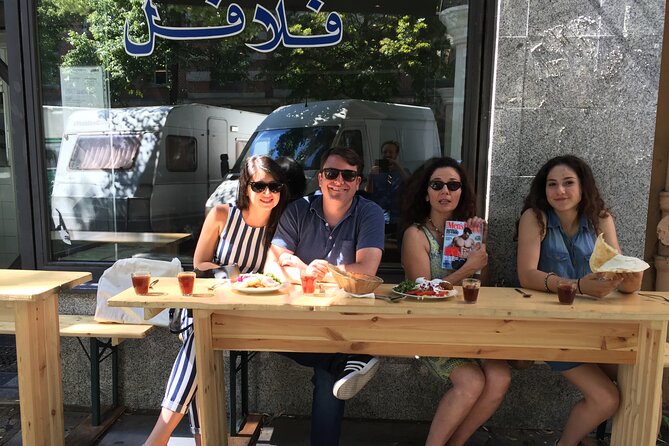
With a maximum of eight people, this is far more personal than a large city walk. You can ask about Berlin’s food traditions, the Wall, Turkish migration, street art, or your own interests without shouting over a crowd.
That matters most during the food stops. Small groups can usually gather around a counter or table more easily, and the guide can explain what you are eating instead of handing you a sample and moving on.
The pace remains active. You walk between Friedrichshain, the East Side Gallery, and Kreuzberg, with several short tasting stops. Most people can take part, service animals are allowed, and the route stays near public transport. The tour ends at U Kottbusser Tor on the U8 and U1 lines, which makes it easy to continue exploring Kreuzberg or return to another part of Berlin.
The meeting point or start time can change by season, so check the operator’s confirmation email before setting your day around the route. At present, the stated start is noon at Industriepalast Hostel, Warschauer Strasse 43.
Who should book this Berlin food walk?
I would choose this tour if you want food and neighborhood context in one outing. It works especially well early in a Berlin visit, when you are still learning the city’s geography and want a guide to connect Friedrichshain, the Wall, and Kreuzberg.
It also suits curious eaters who want more than traditional German dishes. Turkish, Ukrainian, vegan, and modern Berlin food all have a place here. You do not need to be an expert on history or street art. The guide supplies the background as you walk.
I would think twice if you want a slow food tour with long meals, premium restaurants, or large portions of every dish. I would also look elsewhere if your main goal is a detailed Berlin Wall tour. The Wall stop is meaningful but short, and the route gives equal weight to food, art, and neighborhood history.
The experience is offered in English. Free cancellation is available up to 24 hours before the start time, and the tour may be moved or refunded if its minimum group size is not reached.
Should you book East Meets West?
Book it if you like eating your way through a city and want the meal to explain the place. The strongest parts are the small group, the mix of food cultures, the East Berlin to Kreuzberg route, and the guides who bring personality to the history.
At $169.38, the value depends on your priorities. For six tastings, drinks, beer, and three and a half hours of guiding, it is not a bargain food crawl. But if you would otherwise pay for a separate neighborhood walk and still want to sample Berlin’s immigrant and modern food culture, the price becomes easier to justify.
Come hungry, wear good walking shoes, and keep your expectations realistic. You are signing up for a fast-moving introduction to Berlin through food, art, and memory, not a long lunch or a formal historical tour.
FAQ
Where does the tour start?
It starts at Industriepalast Hostel, Warschauer Strasse 43, 10243 Berlin, Germany.
Where does the tour end?
The walk ends at U Kottbusser Tor, which is served by the U8 and U1 lines.
What time does the tour begin?
The stated start time is 12:00 pm.
How long does the experience last?
The tour lasts approximately 3 hours and 30 minutes.
How large is the group?
The maximum group size is eight travelers.
What food and drinks are included?
The experience includes six local tastings, beverages, food tastings, and local Berliner Pilsner beer.
Is a vegetarian option available?
Yes. You should advise the operator of your vegetarian requirement when booking.
Should I tell the operator about dietary requirements?
Yes. Specific dietary requirements should be provided at the time of booking.
Is public transportation included?
No. A BVG transport ticket is not included.
Can I cancel for a full refund?
Yes. You can cancel at least 24 hours before the local start time for a full refund. Changes or cancellations made less than 24 hours before the start are not accepted for a refund.
Just added around Berlin
- Berlin Food & Cultural Tour: Must-Try German & Berliner Classics★ 5.0 · 51 reviews
- The Real Berlin Walking Tour: Art, Food and Counterculture★ 5.0 · 38 reviews
- Private Tour: Daytime Food Tour Trends & Classics★ 5.0 · 24 reviews
- Small-Group Berlin Sightseeing and Food Tour of Prenzlauer Berg and Mitte★ 5.0 · 25 reviews
- Classic Bites and Culinary Trends Neighborhood Food Tour in Berlin★ 5.0 · 191 reviews
- Berlin Evening Culinary Tour – Award Winning★ 5.0 · 118 reviews
- The 10 Tastings of Berlin Kreuzberg Private Food Tour With Locals★ 4.5 · 31 reviews
- Private Berlin Street Food Tour by Bike★ 5.0 · 87 reviews
Food Tours in Berlin, compared.
Berlin Center Food Tour with 8+ Authentic Local Tastings
Read our review →
Downtown Food Tour with 8 Authentic Local Tastings
Read our review →
Disgusting Food Museum Entry Ticket and Tasting
Read our review →
East Berlin Food & History Tour with Eating Europe
Read our review →
Classic Bites and Culinary Trends Neighborhood Food Tour in Berlin
Read our review →Browse the lists this tour appears in